In honor of Dr. Denise Crossan’s arrival in Swarthmore today, we’re launching a new promotional video presentation about the Northern Ireland Semester. Watch it here or at https://vimeo.com/52799720
Dr. Crossan is the Regional Director of the Swarthmore College Northern Ireland Semester Programme. Visit http://northernireland.swarthmore.edu If you are even vaguely interested in the Northern Ireland Semester, please contact Rosa Bernard (rbernar1) in the Off Campus Study office TODAY to see if you can arrange to meet with Denise Crossan about the possibility of studying in Northern Ireland. You don’t have to commit to the program to chat and imagine what your semester in Northern Ireland might look like. There will also be a general information session about the program on Tuesday at noon in Sharples Room 6, which you are welcome to attend.
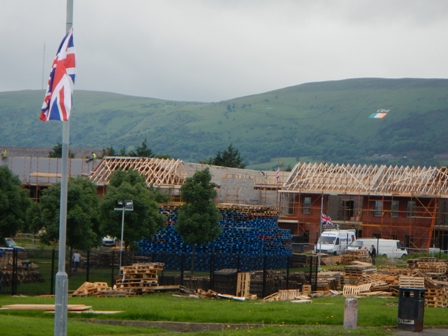
Many organizations and communities in Northern Ireland have used public ritual and symbols, such as parades, bonfires, murals, and commemorations to build and sustain collective identities during the region’s longstanding conflict. However, Northern Ireland is now in an important phase of conflict transformation. What role, if any, can symbolic rituals play in dealing with the past and improving community relations? Emphasis will be placed on Protestant unionists, and loyalists.
An influential 2011 Harvard Business Review article hailed the re-construction of capitalism and the development of a “shared value” approach to business practice. In this talk, drawing on public policy initiatives around the world, Dr. Denise Crossan will explore the complexity of the concept of social entrepreneurship and review how the private sector and international governments are supporting and growing new organisational forms that strive to deliver an equally weighted social and economic return value for their stakeholders.
Dr. Denise Crossan was appointed to Trinity College Dublin’s School of Business in January 2009 as Assistant Professor in Social Entrepreneurship; the first post of it’s kind in Ireland. She currently teaches at undergraduate and postgraduate levels, and her research interests include mapping social entrepreneurship in an international context; the measurement of social value and ethical practice in social entrepreneurship; international public sector policies to grow social entrepreneurship and understanding corporate social responsibility and blurring sector boundaries.
In 2012 she received the Emerald Literati Network Awards for Excellence, Highly Commended Award Winner, for her paper entitled “The Hologram Effect in Entrepreneurial Social Commercial Enterprises: Triggers and Tipping Points” published in the Journal of Small Business and Enterprise Development (Vol. 18, No. 4, 2011). Dr. Crossan’s in-field experience includes working as Community Business Advisor under the European Union’s Special Programme for Peace and Reconciliation in Northern Ireland from 1996 to 2002, and Dr Crossan acts as the Regional Director of the Swarthmore College Northern Ireland Semester Programme.
Sponsored by Swarthmore’s Study Abroad Office, Lang Center for Civic and Social Responsibility, Peace and Conflict Studies, and Sociology and Anthropology
Interested in conflict and peacebuilding? Social entrepreneurship and sustainable organizing?
Come learn about the Northern Ireland Semester, a study abroad program of Swarthmore College. We will hold an orientation session on Thursday, September 20th at 3:30 in SC145. Dr. Denise Crossan (Trinity College Dublin), our in-country supervisor and instructor, will join us via Skype.
The program provides students a unique opportunity to study conflict, ongoing peacebuilding efforts, and social entrepreneurship in local communities in Northern Ireland, a region in a critical transition after 30 years of violent political and ethnic struggle. Students work (for supervised credit) within local community organizations while studying conflict, peace, and reconciliation at the Irish School for Ecumenics of Trinity College at its Belfast campus. Community placements can be tailored to fit your particular academic interests (e.g. theatre as peacebuilding, culture and conflict, transitional politics, segregated education, cross-border economics, etc.)
The Northern Ireland Semester is based in two geographic locations, Derry / Londonderry or Belfast, but student involvement with community groups may take place elsewhere in Northern Ireland. Students may register for one semester or two, and further possibilities for summer research and /or service work may arise.
Drawing on almost twenty years of studying and traveling to Northern Ireland, including sustained periods of intensive fieldwork, Smithey focuses on the importance of collective identity change that is central to conflict transformation. He argues that it is important for ethnopolitical division to be addressed from within ideologically committed quarters of divided societies. In this case, he finds that many unionists and loyalists are modifying symbolic and often ritualistic expressions of collective identity that have often been considered divisive, such as parades, bonfires, and murals, and
are making them less polarizing. The development and modification of these activities provide opportunities for the incremental reframing of fundamental ethnopolitical ideas and narratives. If you are interested in studying peace processes from grassroots psychocultural angles, this book might appeal to you.
Information Technology Services has installed two interactive resources on the PC in the Sociology and Anthropology lab in Kohlberg Hall. Both pertain to Northern Ireland, but have broader relevance to political contention (violent, nonviolent, and institutional), material culture, ethnicity, nationalism, propaganda, etc.
If you would like to access these resources, please contact Rose Maio in the Department of Sociology and Anthropology about lab hours and access to the lab.
On the PC’s desktop, you will find two icons:
One is for A State Apart an interactive history of the Troubles in Northern Ireland with video, audio interviews, timelines, journalism, and documents. It provides an excellent overview of the conflict in a very compelling way. (This would be an excellent primer for students planning to study in Northern Ireland.)
The second is for Troubled Images a resource produced by the Political Collection of the Linenhall Library in Belfast. They have scanned thousands of images and documents from the collection and organized them in a searchable database which is now in the SOAN lab. Here you will find posters, campaign leaflets, photographs, political cartoons, lapel pins, flags, stamps, etc. etc.
Many thanks to ITS for making this resource available to us and our students.
Hannah Kurtz ’13 (a special major in Peace and Conflict Studies) and Josh Satre ’13 arrived in Northern Ireland today to begin their semester of study at the Irish School for Ecumenics (Trinity College Dublin at Belfast) and other community-based coursework. They met with Laura Couser at the Bytes Project.
They are pictured here in the Bytes HQ with Northern Ireland Semester adviser, Adree Wallace, and Laura Couser of the Bytes Project.
Lee Smithey recently sat down with Reina, Maurice, Jessa, and two of the program’s in-country facilitators, Dr. Denise Crossan and Ms. Adree Wallace at the Lang Center for Civic and Social Responsibility.
You can listen in on the conversation and learn more about the Northern Ireland semester via this podcast:
from left to right: Jessa Deutsch ’10, Maurice Weeks ’09,
Lee Smithey, Reina Chano ’09, Denise Crossan,
Adree Wallace
For more information on Peace and Conflict Studies and the Northern Ireland semester, please contact Lee Smithey or the Office for Foreign Study.


 The Creative Destruction of Capitalism and the Rise of Social Entrepreneurship