Bibliographer: Nicholas Mayo
Munster Village, a novel
Traditional Description
Walker, Mary, Lady. Munster Village, A Novel. 1st. Ed. London: Printed for Robson and Co. New Bond Street, 1778.
Transcription Vol I:
MUNSTER VILLAGE | A | NOVEL | IN TWO VOLUMES | VOL I. | LONDON | Printed for Robson and Co. New Bond Street; | Waltzer, Charing Crofs; | And Robinson, Paternoster Row, | M.DCC.LXXVIII.
Transcription Vol II:
MUNSTER VILLAGE | A | NOVEL | IN TWO VOLUMES | VOL II. | LONDON | Printed for Robson and Co. New Bond Street; | Waltzer, Charing Crofs; | And Robinson, Paternoster Row, | M.DCC.LXXVIII.
Pagination:
Vol. I 205.
Vol II 262.
Format: 8mo.
Contents Vol I:
A1r cover page
A1v title
Br-O5v text
O6r advertisement
Contents Vol II:
A1r cover page
A1v title
Br-S2 text
Notes: Both volumes sourced from the Bodleian Library in Oxford, facsimile accessed through ECCO, Gale Document Number: CW3316601754, First Volume ends with “End of the First Volume.” Final page in First Volume advertises another novel: “Just Published | The SECOND EDITION | in Five Small Volumes, price 15s. bound | LETTERS | FROM THE | Duchess De Crui and Others |.” Second Volume ends with “FINIS.”
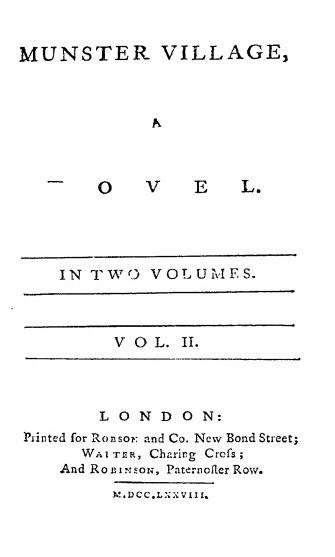
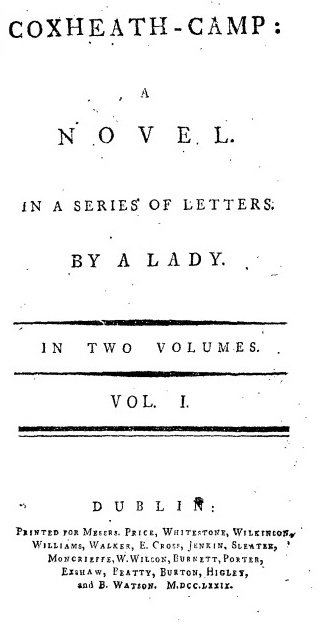
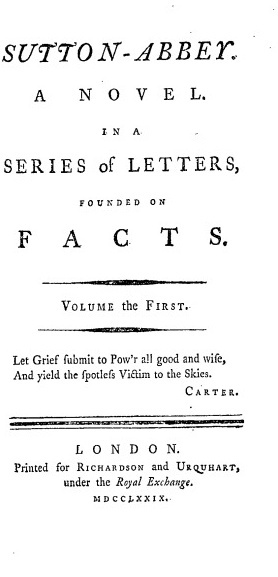
Three Sets of Minimalism in Three Centuries
Sol LeWitt in "Paragraphs on Conceptual Art" (1967): "What the work of art looks like isn't too important. It has to look like something if it has physical form. No matter what form it may finally have it must begin with an idea. It is the process of conception and realization with which the artist is concerned.”
Its interest in the white of the page and its intrigue in a place "Munster Village" (rather than the peoples we often see at the center of titles) may have equally generated curiosity and judgement, and it is this mix of feelings and impressions I searched for in my work on this bibliography. I wondered, what in more recent times evokes such questions of materiality, space, and authorship? Put more explicitly, how could I get into the mind of a denizen at Robson and Co's bookstore? Can one feel dumbstruck and denunciatory?
Additionally, descriptive bibliographies seemed to lack exactly what I hope to provoke through the juxtaposition of my 9 images. Concerned more with legibility, these text-based bibliographies seek to summarize the specifics of a novel's form so as to make the most "important" and "salient" elements of that form easily accessible. By placing novel title pages from the 1770s with Minimalist Art works from the 1960s, I intend to generate questions about materiality. Minimalism in the Art world of the 60s was a movement that self consciously sought to contrast the concern with authorship and subjectivity of its conceptual predecessor, Abstract Expressionism. Indeed, theartstory.org writes, "The new art favored the cool over the "dramatic": their sculptures were frequently fabricated from industrial materials and emphasized anonymity over the expressive excess of Abstract Expressionism." It is this intersection and tension between anonymity (as found through materiality) and the very idea novels began with, exemplarity. I am interested in how the novel, as a self consciously defined genre of fiction, reckons with this tension, not in its content but rather in its material form.
The final three images are headers from some of todays most popular blogs centered around our contemporary manifestation of minimalism (a life philosophy that--broadly put--seeks happiness through a decluttering, both figuratively and literally, of the lives made in consumerist societies, in which items and actions not offering immediate emotional or financial benefit are superfluous, and thus need be discarded). It is the most experimental part of my bibliography, but I was curious to see what question or thoughts such an odd juxtaposition could create. Despite the jumps in time, can we trace a line through these three sets of minimalism? Is their continuity in their concern for materiality? Is their continuity in their interest in exemplarity?