Bibliographer: Moeko Noda
The Mutability of Human Life; or, Memoirs of Adelaide, Marchioness of Melville
Traditional Description
Anonymous. The mutability of human life; or, memoirs of Adelaide, Marchioness of Melville. In three volumes. London: Printed for J. Bew, in Pater-Noster-Row. 1777.
THE | MUTABILITY | OF | HUMAN LIFE; | OR, | MEMOIRS | OF | ADELAIDE, Marchioness of MELVILLE. | By a LADY. | IN THREE VOLUMES. | VOL.I. | LONDON, | Printer for J.BEW, in Pater-Noster-Row. | 1777.
Pagination. I 256p; II 273p; III 232p.
Collation. 12mo. Vol 1: B-L6, M4; Vol 2: B-M6, N3; Vol 3: B-K6, L4
Contents. Vol 1: p.1 title, p.2 half title, p.249-256 text. Vol 2: p.1 title, p.2 half title, p.271-273 text. Vol3: p.1 title, p.225-232 text.
Notes. All three volumes sourced from the Harvard University Houghton Library. Digital facsimile retrieved from the Eighteenth Century Collections Online, ESTC number: N010299. Duplication in digital facsimile found in Vol 1(p.234-235) and Vol 3 (p.104-105), but they appear to be print errors and not from the original copy.
Experimental Description
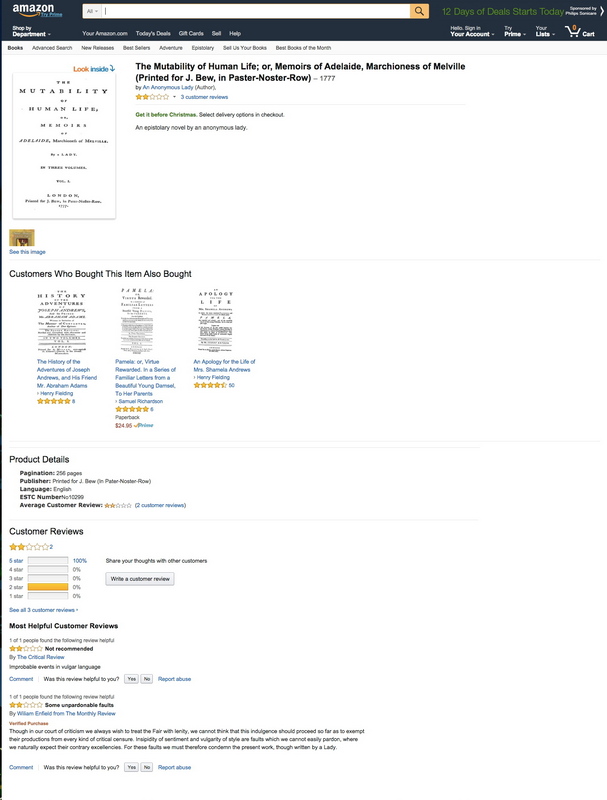
This experimental bibliography of the novel The Mutability of Human Life; or, Memoirs of Adelaide, Marchioness of Melville attempts to capture the increasing nature of books as commodities in the eighteenth century. The amazon page style bibliography seeks to capture the way these novels were, with the rise of the middle class and its literacy, increasingly treated as commodities to be advertised and sold.
This project was done in the hopes of capturing the aspect of novels as commodities. In the modern era, an amazon page is one of the first places people look for information on a book they consider to purchase. The page, targeted at consumers to provide them with information that would convince them to purchase the book, is a bibliography tailored for the customer. In creating this experimental bibliography, I took the image and data of the novel, The Mutability of Human Life; or, Memoirs of Adelaide, Marchioness of Melville, and created an amazon page of the novel as it may have looked back in 1777 when it was first published. The page includes traditional bibliographic data such as image, title, publication date, and author, as well as advertising material such customer reviews and recommendations for other best sellers.