Bibliographer: Emma Haviland-Blunk
Louisa Wharton - A Story Founded on Facts: Written by Herself, in a Series of Letters to a Friend
Traditional Description
Wharton, Louisa. Louisa Wharton. A story founded on facts: written by herself, in a series of letters to a friend. London: T. Sabine, 1780.
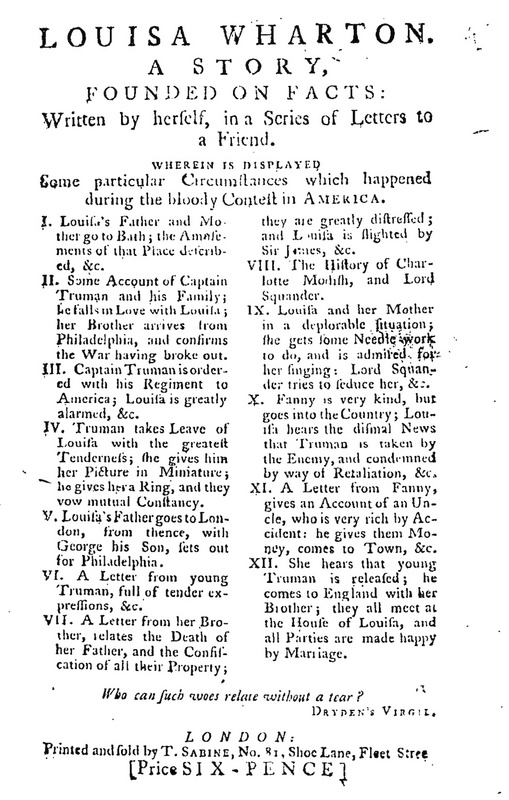
{Title is centered.} LOUISA WHARTON. | A STORY, | FOUNDED ON FACTS: | Written by Herself, in a Series of Letters to | a Friend. | WHEREIN IS DISPLAYED | Some particular Circumstances which happened | during the bloody Contest in AMERICA. | {The following appears in two columns; Roman numerals closer to the margin, words are indented slightly.} I. Louisa's Father and Mo- | ther go to Bath; the Amuse- | ments of that Place describ- | ed, &c. | II. Some Account of Captain | Truman and his Family; | he falls in Love with Louisa; | her Brother arrives from | Philadelphia, and confirms | the War having broke out. | III. Captain Truman is order- | ed with his Regiment to | America; Louisa is greatly | alarmed, &c. | IV. Truman takes Leave of Louisa | with the greatest | Tenderness; she gives him | her Picture in Miniature; | he gives her a Ring, and they | vow mutual Constancy. | V. Louisa's Father goes to Lon- | don, from thence, with | George his Son, sets out | for Philadelphia. | VI. A Letter from young | Truman, full of tender ex- | pressions, &c. | VII. A Letter from her Bro- | ther, relates the Death of | her Father, and the Confis- | cation of all their Property; | {new column begins here, to the right} they are greatly distressed; | and Louisa is slighted by | Sir James, &c. | VIII. The History of Char- | lotte Modish, and Lord | Squander. | IX. Louisa and her Mother | in a deplorable situation; | she gets some Needle work | to do, and is admired for | her singing: Lord Squan- | der tries to seduce her, &c. | X. Fanny is very kind, but | goes into the Country; Lou- | isa hears the dismal News | that Truman is taken by | the Enemy, and condemned | by way of Retaliation, &c. | XI. A Letter from Fanny, | gives an Account of an Un- | cle, who is very rich by Ac- | cident: he gives them Mo- | ney, comes to Town, &c. | XII. She hears that young | Truman is released; he | comes to England with her | Brother; they all meet at | the House of Louisa, and | all Parties are made happy | by Marriage. | {italicized and centered} Who can such woes relate without a tear? | {right-aligned} DRYDEN’S VIRGIL. | {italicized} LONDON: | Printed and fold by T. SABINE, No. 81, Shoe Lane, Fleet Stree{.} | {centered} [Price SIX - PENCE]
Format & Pagination
64 p. 8mo. 4s. {This work is bound in gatherings of 4, which creates a half-sheet octavo.}
Contents
A1r: Images. A1v: Title and contents. A2r-H4v: Text.
Notes
Sourced from the British Library; digital facsimile accessed through Eighteenth Century Collections Online (Gale Document Number: CW113305389). Louisa Wharton is a pseudonym, but the real author is unknown.
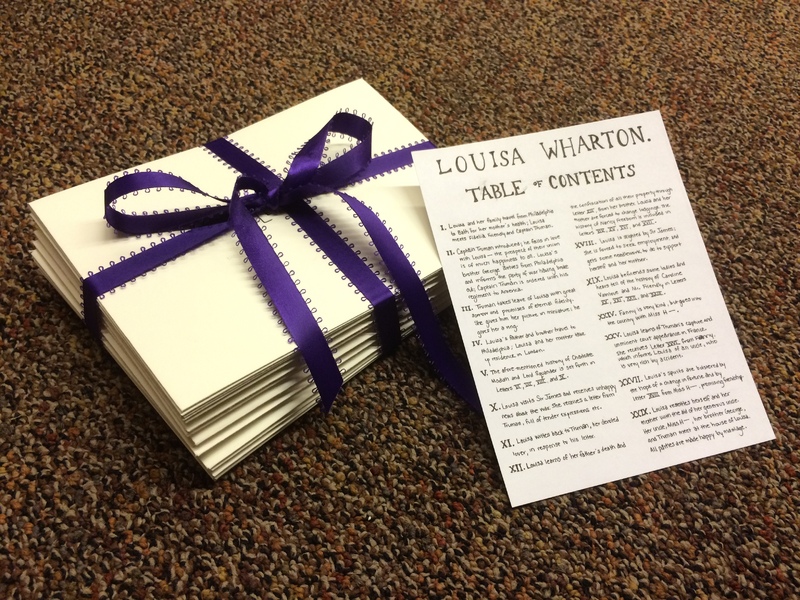
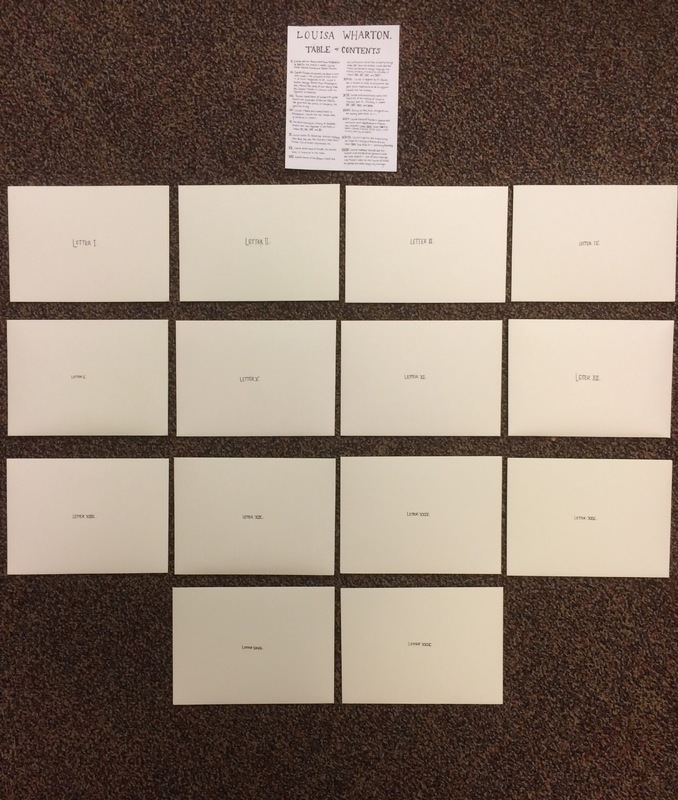
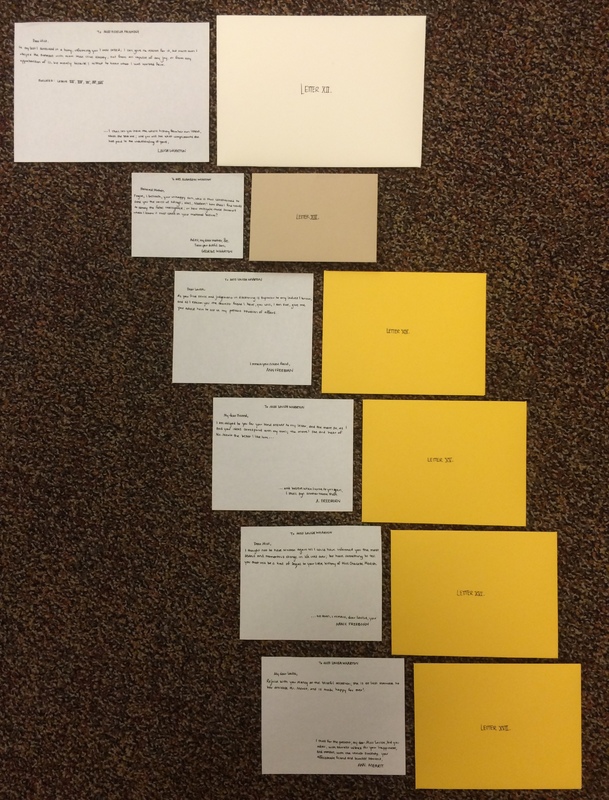
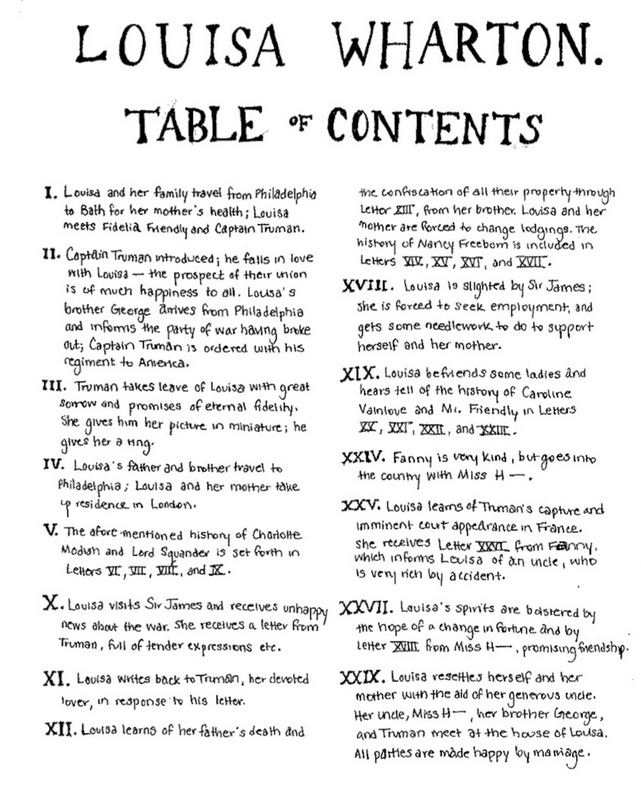
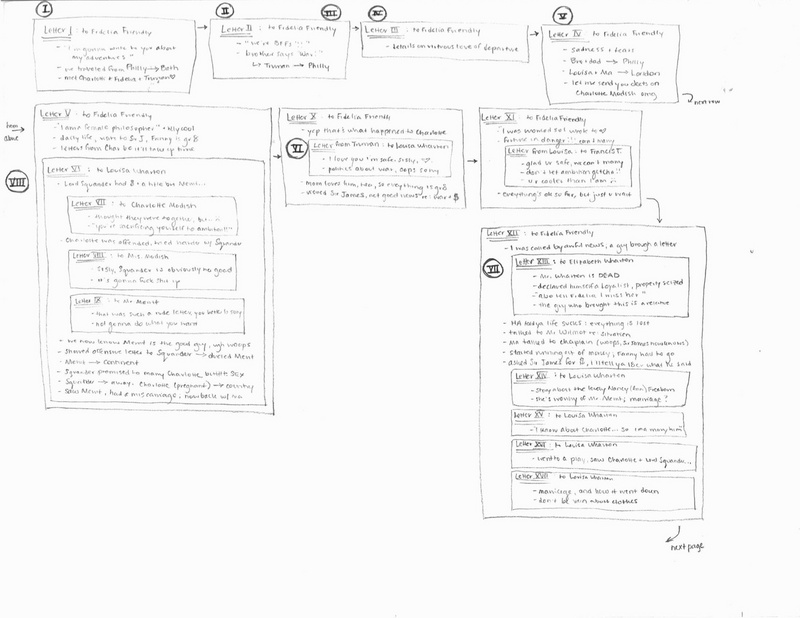
My experimental bibliography explores the complex nature of the epistolary form of Louisa Wharton that is simply missing from the traditional bibliography and the digital facsimile of the novel. I have (re)created the letters themselves that are at the core of this epistolary novel to allow for a better understanding of the physicality of letters within letters that a printed book—let alone a digital facsimile—has trouble capturing; I have also recreated the table of contents to better represent the main plot points and the course of action in the novel, giving readers a fuller knowledge of the content of this book that its format is unable to provide.
My experimental bibliography explores the complex nature of the epistolary form of Louisa Wharton that is simply missing from the traditional bibliography and the digital facsimile of the novel. I have (re)created the letters themselves that are at the core of this epistolary novel to allow for a better understanding of the physicality of letters within letters that a printed book—let alone a digital facsimile—has trouble capturing; I have also recreated the table of contents to better represent the main plot points and the course of action in the novel, giving readers a fuller knowledge of the content of this book that its format is unable to provide.
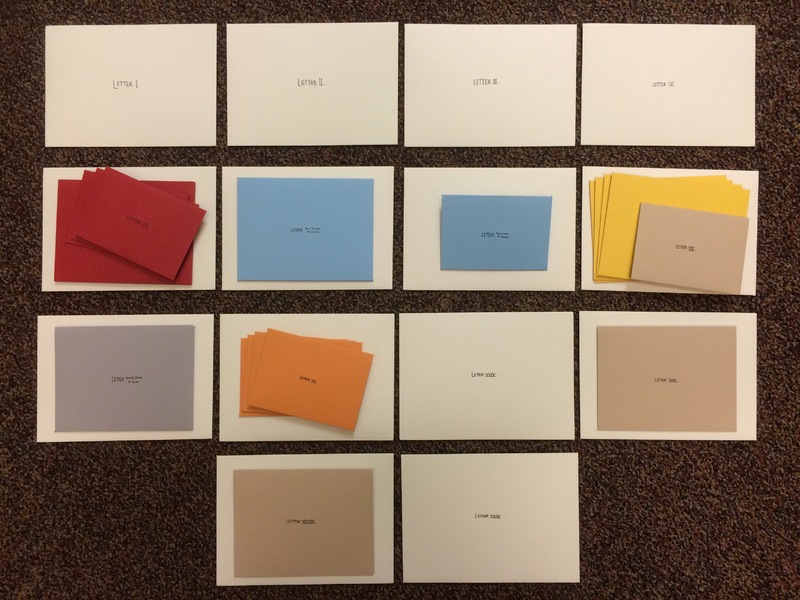
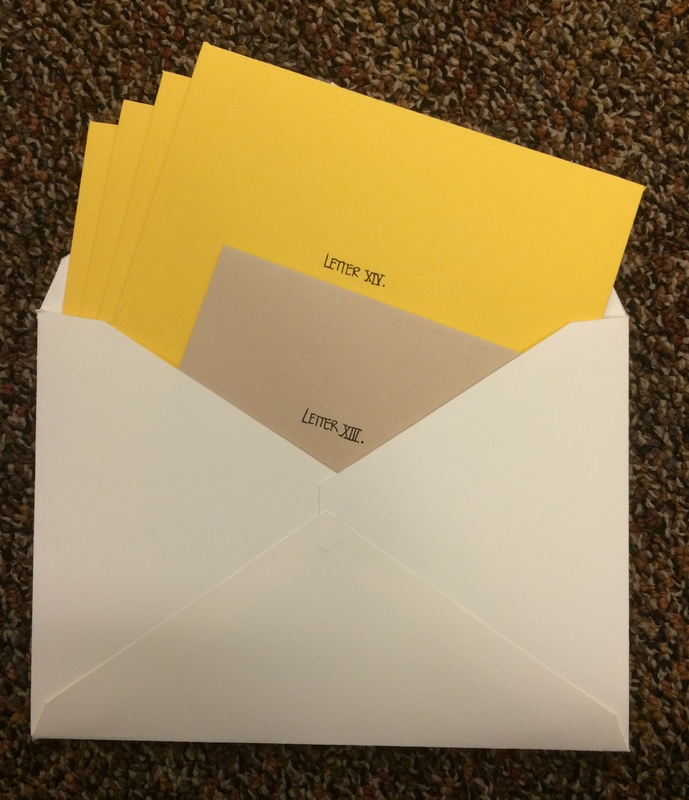
The project takes the form of a series of envelopes of different sizes and colors—the smaller sizes are enclosed within the largest size (which represents the main plot line) to represent how convoluted the flow of the narrative is, with additions of side stories and anecdotes that aren’t necessarily essential to the plot. The story within the largest series of fourteen envelopes is detailed in the table of contents; these letters are all written by Louisa Wharton to her dear friend Fidelia Friendly. Within these envelopes, there are two sets of smaller envelopes: the middle-size series of envelopes contains letters written to Louisa Wharton by other characters, and the smallest series of envelopes contains letters written to other characters in the novel by other characters or Louisa herself that are nonetheless important to the main story or one of the subplots.
These two smaller sizes of letters also follow a color scheme, which describes the story they contain as it can be categorized by common color associations and symbolism. The envelopes of the letters belonging to the Modish story are all a deep red, which symbolizes Charlotte Modish’s misguided passions and her ultimate shame and downfall (in a sense, the envelopes are their own type of scarlet letter). The envelopes containing letters to and from Francis Truman are a light blue, meant to symbolize the faith and loyalty between the pair of lovers. The envelopes containing letters between Caroline Vainlove and Edward Friendly are a calm orange, which symbolizes attraction, encouragement, and happiness, and foreshadows Friendly’s eventual success in winning Caroline’s heart. The envelopes with the letters from Nancy Freeborn are a solid yellow to indicate freshness, joy, and cheerfulness, all qualities Nancy seems to possess and which eventually win her Mr. Merrit. The envelope containing the letter from Sir James is grey to symbolize the emotionless and formal communication that so deeply offends our dear heroine. The remaining envelopes with letters to and from other miscellaneous characters are a light brown, simply symbolizing friendliness and steadfastness, as all the characters writing these letters are friendly to Louisa and her story.
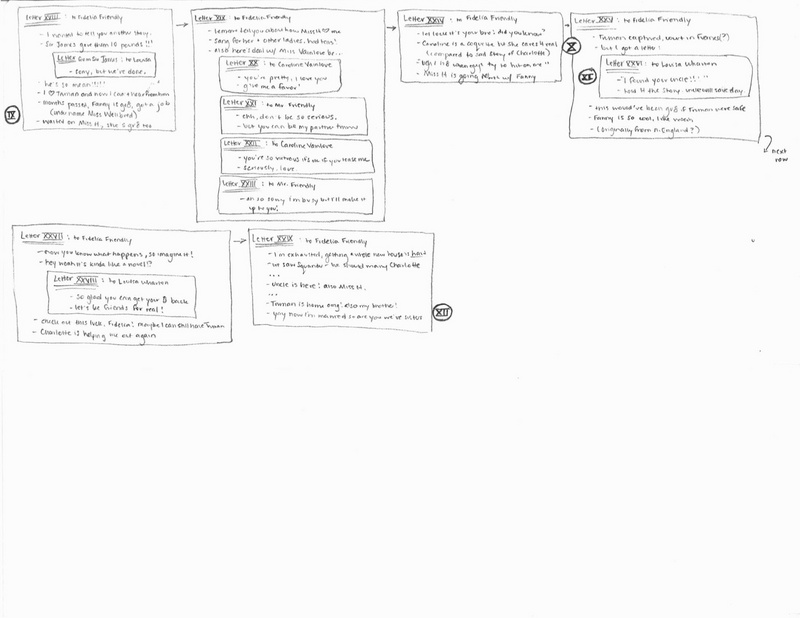
Also included in this experimental bibliography is the re-imagined table of contents, which was modeled after the original title page and gives a better sense of the true plot arc and side stories. To give a sense of my process in visualizing the development of the novel, I have also included my initial diagram of how the letters in this novel work: which letters are inside other letters, how they correspond to each other, and how they relate to the potential “table of contents” that is represented on the original title page of the novel.