Bibliographer: Justine Albers
Love and Madness
Traditional Description
Croft, Herbert, Sir. Love and madness. A story too true in a series of letters between parties, whose names would perhaps be mentioned, were they less known, or less lamented. A new edition. London, 1780.
LOVE AND MADNESS.|A|Story too True|in a|SERIES of LETTERS|Between Parties, whose Names would|perhaps be mentioned were they less|known, or less lamented:|[horizontal rule]|Governor. "Who did the bloody deed?|Oroonoro. "The deed was mine,|"Bloody I know it is, and I expect|"Your laws should tell me so. Thus, self condemmed,|"I do resign myself into your hands,|"The hands of Justice."|OROONORO.|[horizontal rule]|A New Edition.|[horizontal rule|LONDON.|Printed for G.KEARSlY, at No.46,near Serjeants Inn,|Fleet Street; and R.FAULDER,in New Bond Street.|[horizontal rule]1780.[horizontal rule]|
Pagination
12mo. Vol.1. B6-Z6. Aa6-Cc6r. 309 leaves. i-viii, 1-298.
Contents
title. i-viii contents. ix preface. x dedication/poem. 1-298 text.
Notes
Sourced from the British Library. Digital facsimile retrieved through Eighteenth Century Collections Online. Gale Document Number: CW3314147238. Duodecimo in 6's, meaning that only signatures 1-3 for each letter appear (B1-B3signatures present, next 6 pages are blank, then C starts, and so on). Newspaper clippings, a poem and a picture of the author from a 1794 edition of the European Magazine precede the title page. Illegible cursive handwriting on the title page.
Experimental Description
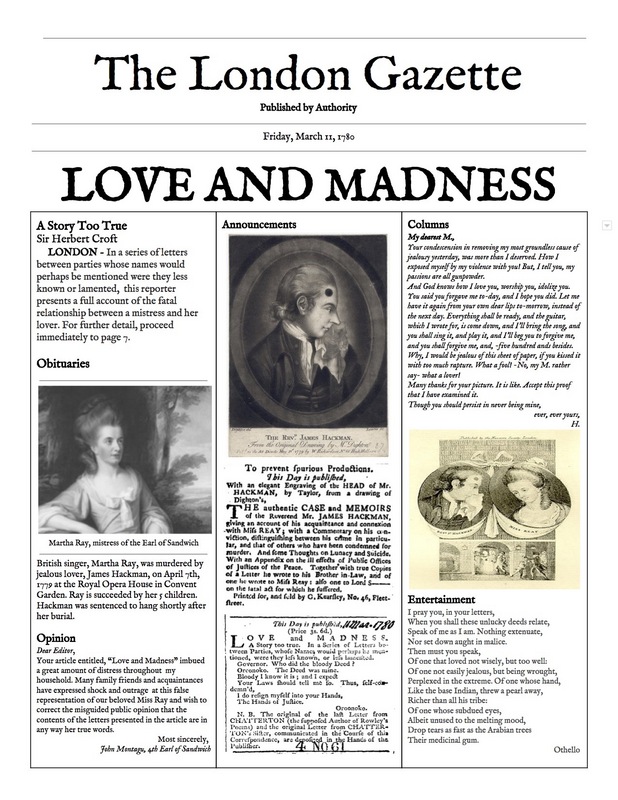
Inspired by newspaper clippings I found at the front of the digital facsimile, I have created a mock-18th century newspaper cover page to emulate the relationship between the newspaper and the novel and further explore Anderson's idea of imagined communities that are created through literary works.
Given this information, and the fact that many 18th century novels were released serially in newspapers or magazines, I thought it would be interesting to represent the novel in the different sections of the paper, and to think about what kind of "imagined community" I could create with this type of representation. The headlining article is meant to represent Croft's presentation of the novel to the public. I follow this with an obituary for Martha Ray, and then a fictional letter to the editor from the Earl of Sandwich expressing concern that the public was reading the letters as though they were real. I also found an newspaper clipping anouncement about the publication of the novel at the front of the digital facsimile and included this, as well as another about the publication of the memoirs of Hackman (again, fictional) by another author that I found online. Finally, I have an excerpt from one of the letters in the novel as well as the poem included in the dedication in the last column of my paper.