Bibliographer: Helen Wang
The Unfortunate Union: or, the Test of Virtue
Traditional Description
Anonymous. The unfortunate union: or, the test of virtue. A story founded on facts, and calculated to promote the cause of virtue in younger minds. Written by a Lady. 1st ed. London: Richardson and Urquhart, under the Royal Exchange, and at No. 46, Pater-Noster-Row, MDCCLXXVIII, 1778.
[230x700mm abstract signature] THE [230x450mm Indistinguishable abstract signature] | OR, THE | TEST OF VIRTUE. | A | STORY founded on FACTS, | Calculated to promote the Cause of VIRTUE | in Younger Minds. | Written by a LADY. | VOL. I. | LONDON, | Printed for RICHARDSON and URQUHART, | under the Royal Exchange, and at | No. 46, Pater-noster-Row. | MDCCLXXVIII.
Pagination: 2-197
Format: 2v; 12mo
Contents: B1r title/text, B1c-L5v text
Notes:
Recorded from Eighteenth Century College Online database scan from source library Harvard University Houghton Library. Epistolary fiction. Literature and language. Two volumes. There is a signature on the scanned title page that is incomprehensible.
Experimental Description
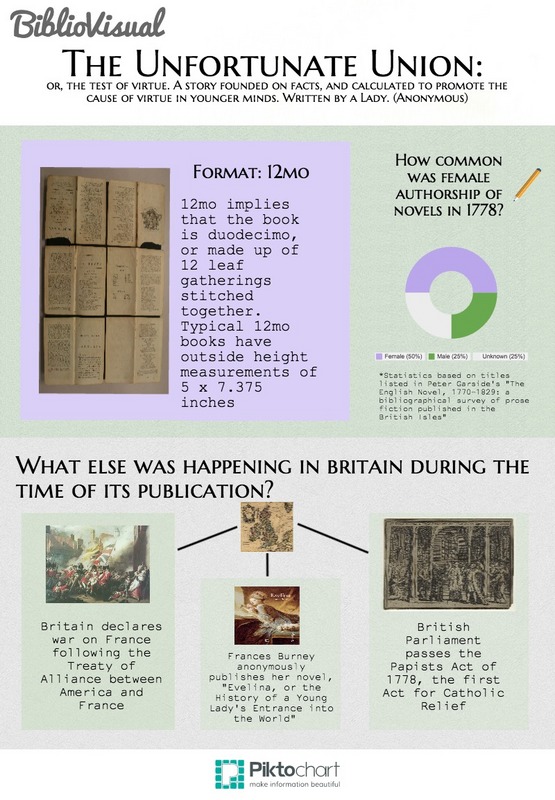
Without context, traditional bibliographic description can be opaque to the common reader. Simple visualizations help readers quickly understand a few key elements of the novel in 1778: format, authorship, and historical context.
In order to create a more informative and holistic experience of using descriptive bibliographies to gather information on novels, I created an infographic called, “BiblioVisual” using online software called Piktochart. My goal was to make descriptive bibliographies more accessible to the common English student. This particular BiblioVisual was made for “The Unfortunate Union: or, the test of virtue. A story founded on facts, and calculated to promote the cause of virtue in younger minds. Written by a Lady.” It includes visual displays of format, authorship, and historical context in order to elaborate on technical information in the traditional bibliography and depict this specific novel in the broader context of novel writing in 1778 Britain.
One potentially cryptic aspect of traditional bibliographies is the format description. A typical college student may be unfamiliar with terms, such as “12mo.” In the BiblioVisual, I include a section providing information about the publishing method of duodecimo books. In addition, there is a clear sample picture and measurements of the typical size of a 12mo book. Because traditional bibliographies are often used instead of hard copies, it is especially important to help students picture the physical qualities of the original novel that are described in technical terms. In turn, they will be more able to understand how the novel was read by its audience in 1778.
The second feature of the BiblioVisual is a graph depicting the gender of British novel authors in 1778. The circle chart shows percentages of female, male, and unknown gender authors. Because this novel is written “By A Lady,” it is interestingly to highlight this because the percentage of female novel authors during this time is, counterintuitively, equal to or higher than the percentage of male authors. Statistics were compiled using the listing of titles in 1778 in Peter Garside’s The English Novel 1770-1829: A Bibliographical Survey of Prose Fiction Published in the British Isles.
The third feature is a visual web of major historical British events in 1778. Although The Unfortunate Union is not advertised as “A History,” like many of the other novel titles, it should be helpful to have some background information about major events happening in Britain at the time. The historical web puts the novel in the context of more well known works, such as Frances Burney’s Evelina, and in relation to major political events, such as the official beginning of the American Revolution and the Parliamentary Acts for Catholic Relief.
Overall, supplementing traditional bibliographies with a BiblioVisual will make them more attractive and accessible. This has the potential to encourage English students to utilize descriptive bibliographies as a helpful source when researching or reading novels.