Bibliographer: Alison Devine
The History of Miss Maria Barlowe
Traditional Description
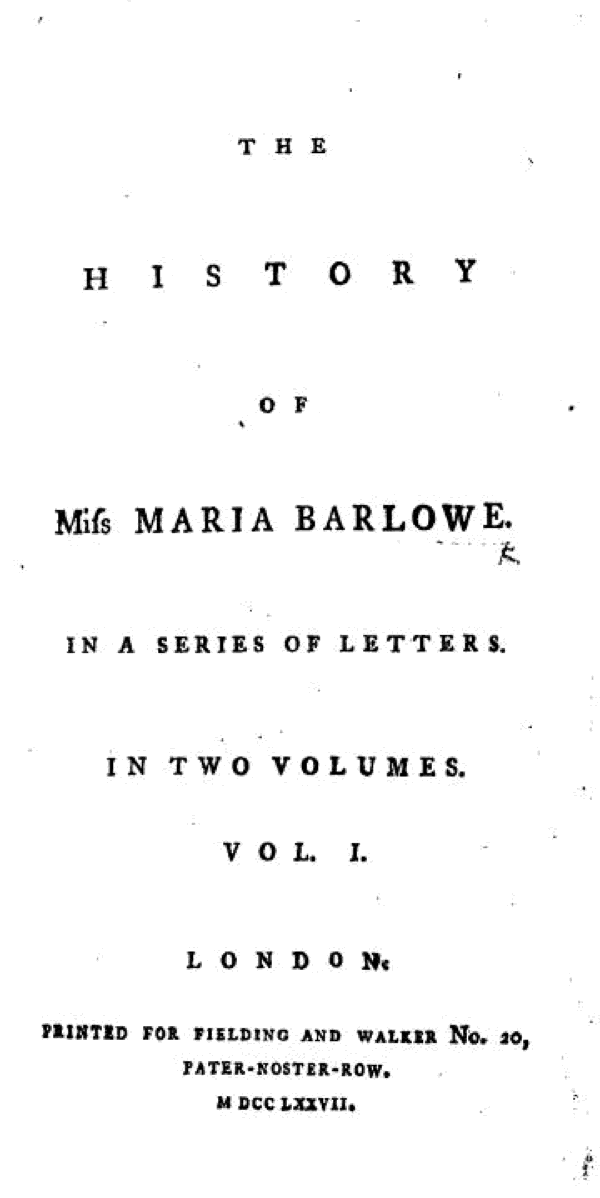
THE HISTORY OF Mifs MARIA BARLOWE. IN A SERIES OF LETTERS. IN TWO VOLUMES. VOL. I. LONDON: PRINTED FOR FIELDING AND WALKER No. 20, PATER-NOSTER-ROW. M DCC LXXVII.
London: Fielding and Walker No. 20, Pater-Noster-Row, 1777.
I 246p; II 233p. 12mo.
Contents. Volume I. A1r coat of arms, A1v “short” title, A2r title, A2v blank, B1r-M3v text
Volume II. A1r title, A1v blank, B1r-M3r text
Notes. Volume I. The first page available for viewing on the electronic facsimile, A1, was printed with an engraving of a coat of arms with the name “John Sherburne” printed in a cursive script underneath. I cannot determine if this was added by the owner of the particular book that was used for this facsimile or if this was part of the original printing; I would assume the former but cannot verify this. Furthermore, I could not concretely determine printing layout of what I have determined to be A1 based on the facsimile. It seems strange that the “short” title page would be printed as the verso next to the primary title page but the facsimile does not indicate that there were any blank pages. This problem also appeared when examining the end of the A folio and the beginning of the B folio. According to the facsimile, there is not a blank page as A2v, which indicates that B1 would begin as the verso of A2; this, to my knowledge is impossible. So, I am making a judgment call that A2v is indeed a blank page and that the ECCO database did not include this as part of the electronic facsimile. This further supports my earlier concerns about the coat of arms and short title.
Volume II. As with Volume I, the facsimile does not include a blank page between A1 and B1, which once again leads me to believe that A1v is indeed blank.
Experimental Description
Proposal for a Visualization-Generating Database of Eighteenth-Century Novels
The following is a proposal for a new mode of bibliographic description which marries and even enhances the data-heavy nature of traditional bibliographic description with the enhanced graphical representation provided by computers.
Goal: To program and maintain a graphics software that can produce multi-dimensional facsimiles of not only scanned texts but of how these texts would appear within the physical book. This program is intended to reconcile seemingly cold traditional bibliographic descriptions with mock-ups of the actual book so that data can be potentially reconciled with object.
Key Features:
Input: This program will include three major categories of input: textual, material, and historical. These inputs will eventually create a catalog of information that can be accessed by type (i.e. “textual,” “material,” or “historical”) or by novel (i.e. be able to view the textual, material, and historical data for the same novel at once).
Textual input: This input function will be designed to intake bibliographic information about the text printed on the pages within the book. This is the bulk of the information currently provided by traditional bibliographies, including publication information, numbering, and so on. This includes precise (or at least as precise as possible) transcriptions of the text as it appears on the title page and any graphics or engravings that appear in text. This section will also require the user to input, if possible, information about font type and size, margins, spacing, etc. as generally printed throughout the book. This will be supplemented by an actual facsimile of the text.
Material input: This input function will be designed to help generate the multi-dimensional graphical representation of the book. This graphical representation will enhance the possibilities of bibliographies by providing as accurate an image as possible of how the text might have appeared upon publication. This will require extreme attention on the part of the user. Input information will include binding information (type of material used for cover, type of binding [e.g. string or glue], folio information, etc.), dimensions (height, width, and thickness of cover, height, width, and thickness of spine, height, width, and thickness of paper, etc.), and other relevant information about the material used to produce the book (type of paper used, type of ink used, etc.). The program will then be able to generate a mock-up of this novel based upon this physical information. This will require extensive programming and rely heavily upon user input. For example, if a user inputs a type of cover material or color that has yet to be input, this new information will have to be researched and verified before it can be made into a simulated image that can be used for the mock-up.
Historical input: This input function will be designed to enhance the first two inputs. Here, the user will be asked to input relevant historical and market information about the book. The proposed categories include price, sales information, criticism, etc. New categories will be generated as necessary. This will help to contextualize and enhance the textual and material information that is also provided.
Output: All of the inputs will be formatted into a user-friendly interface that displays the graphical mock-up on the left-hand side of the screen and with the textual and historical information displayed on the right-hand side of the screen. Eventually, this lay-out will be able to be changed according to the user’s wishes. The graphical mock-up will be able to be turned, open, flipped through, and so on as if it were a real book. The textual and historical information toolbar will allow the user to search the database for particular information.
User Friendliness: Although this program relies upon the input of users to thrive, it is ultimately designed so that even undergraduate students can access and use it in order to better understand a particular text that they are working with. They can “open” and “read through” the mock-up of a novel to get a better sense of what it might be like to read an older (or even first) edition of a book, even if it is not physically accessible to them. It also allows them to easily access relevant historical and other research information within the same program.
This plan for a visualization-generating database of information about eighteenth-century novels draws attention to the distance between data about the book (whether traditional bibliographic description or high-resolution full-text facsimile) and the material book itself by imagining a utopian digital reconciliation between them.